
Marking Wars: A New Hope for Battle-Weary Educators.
Cue Triumphant Fanfare
Not so long ago, in a classroom not so far away…
It is a time of great upheaval. Educators are fighting an ongoing battle against an overwhelming enemy: the marking pile. Both online and off, these brave soldiers must face wave after wave of text and visual submissions which only they can vanquish.
Just when they think the battle can’t get any worse, a new threat emerges from the digital universe: AI-generated assignments.
The marking wars have entered a new era.
But somewhere in the Moodle galaxy, a new ally is preparing to join the fight…
The Empire Strikes Back: The Marking Pile Returns
I have a bad feeling about this.Essay questions, visual designs, technical drawings – all require expert use of the Force (aka human insight) to interpret. Up until very recently, there has not been an automated tool that can efficiently analyse and assess typed essays, let alone hand-written documents, drawings or designs. If you want to run a fully automated, unmonitored e-learning course, you have to avoid these exercises.
Otherwise, you have to make a plan for someone to mark them. Just think about what that involves:Let’s say you have one hundred and fifty essays to mark. At ten minutes each, that’s 25 hours of marking. And that’s assuming you have a clear rubric in place, every answer is straightforward, and nobody has submitted a handwritten script that requires a protocol droid fluent in over six million forms of communication to decipher.
According to the OECD1’s 2024 Teaching and Learning International Survey (TALIS), full-time South African teachers spend an average of 7.1 hours a week marking and correcting learner work, compared with the OECD average of 4.6 hours. That’s nearly an entire working day every week.
Adding to the burden is the fact that marking is much more than just assigning a score. The entire point of this kind of assignment is to be able to evaluate a learner’s grasp of the subject and ability to reason on it. Educators must interpret answers, identify misconceptions, apply assessment criteria and usually provide useful feedback – all of which takes precious time and a great deal of effort. It’s enough to make you go over to the Dark Side.
A New Hope: Reinforcements Have Arrived
At The Learning Studio, we’ve encountered these challenges from both sides of the battlefield. Our clients have asked for better ways to manage marking, while our own e-learning development team has grappled with the limitations of automated assessments. How do you create meaningful essay questions, assess handwritten work or evaluate a learner’s reasoning without placing an enormous marking burden on educators?
We decided it was time to recruit some reinforcements.
The result is The Grading Studio, an AI-assisted grading system developed to work directly within Moodle’s Assignment module.
We wanted something that could handle the initial assessment of essays and other learner-created submissions, including Word documents, PDFs, PowerPoint presentations and scanned handwritten work, without taking professional judgement out of the equation.
Just as importantly, it needed to work with the educator’s own rubrics, assessment guidelines and learning materials, rather than relying on a generic interpretation of what constitutes a correct answer.
The Grading Studio now provides an initial grade, supporting evidence and feedback for educators to review, amend or approve. The intention is simple: reduce the repetitive marking workload while keeping educators firmly in command.
But as we explored the possibilities, we realised that saving marking time was only part of the story.
The Force Is Still with You: Your Rubric, Your Rules
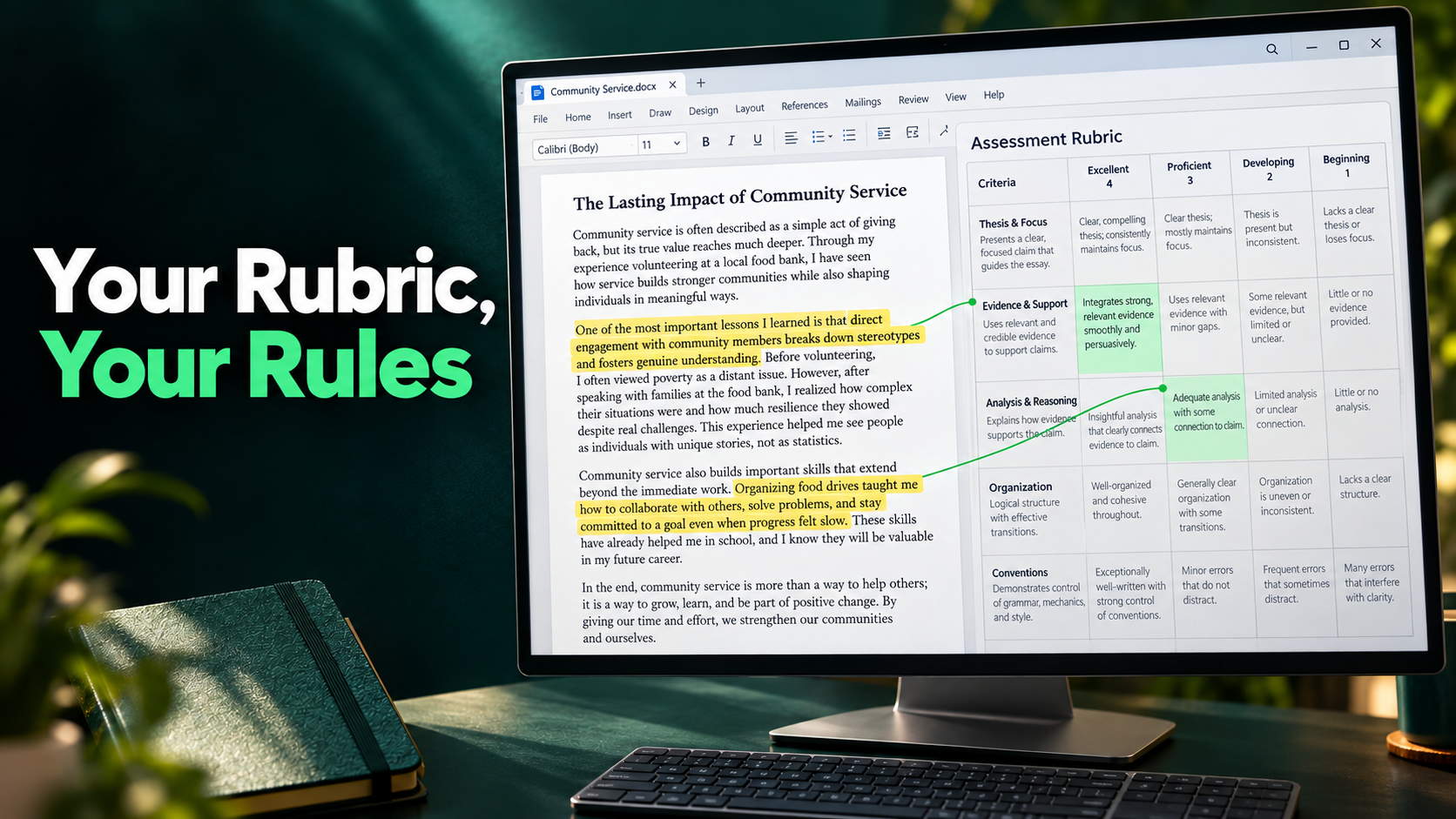
One of the biggest concerns about AI-assisted assessment is whether AI can understand what an educator actually expects. After all, there can be several ways to explain a concept or solve a problem, but assessment must measure the specified learning outcomes, not only the ability to produce a plausible answer.
Imagine a learner who reaches the correct conclusion using a completely different method from the one taught. Should they receive full marks? That depends on what the assessment was designed to measure.
The Grading Studio addresses this by using the educator’s own rubrics, marking guidelines, reference documents and learning content to guide its grading suggestions. This helps ensure that assessment reflects what was taught and what learners were expected to demonstrate, while limiting the influence of unrelated information.
It also helps make marking more consistent. When several educators assess the same assignment, they may interpret the marking criteria differently or award different marks for similar answers. Even a single educator’s judgement can vary when faced with a large pile of submissions and growing fatigue. By applying the same rubric and assessment guidelines to every submission, The Grading Studio provides a consistent starting point for marking, leaving educators to review and make the final decisions.
Ultimately, the educator remains the Jedi Master, reviewing the suggestions, applying professional judgement and making the final decision.
Seeing Disturbances in the Force: What the Marks Reveal

But wait, there’s more…
What if assessing learner work could tell us more than who passed, who failed and who needs to try again?
Consider a class of 60 learners completing an assignment on a scientific process. Most can identify the individual components, but many struggle to explain how they interact.
An educator might notice this while marking, but identifying patterns across an entire class takes time. The Grading Studio’s reporting capabilities make it easier to spot where learners repeatedly lose marks and investigate why.
Perhaps the learning material needs clearer explanations or more worked examples. Maybe learners lack a foundational skill, or the assessment question itself is unclear.
This is particularly useful for e-learning content creators and training providers who cannot always observe learners at work. By highlighting recurring difficulties, assessment results can help educators identify where teaching methods, learning materials or assessment questions may need improvement.
In other words, assessment becomes a final judgement on learner performance, AND it becomes a source of information that can be used to improve the learning experience itself.
The Feedback Awakens: Help While It Still Matters
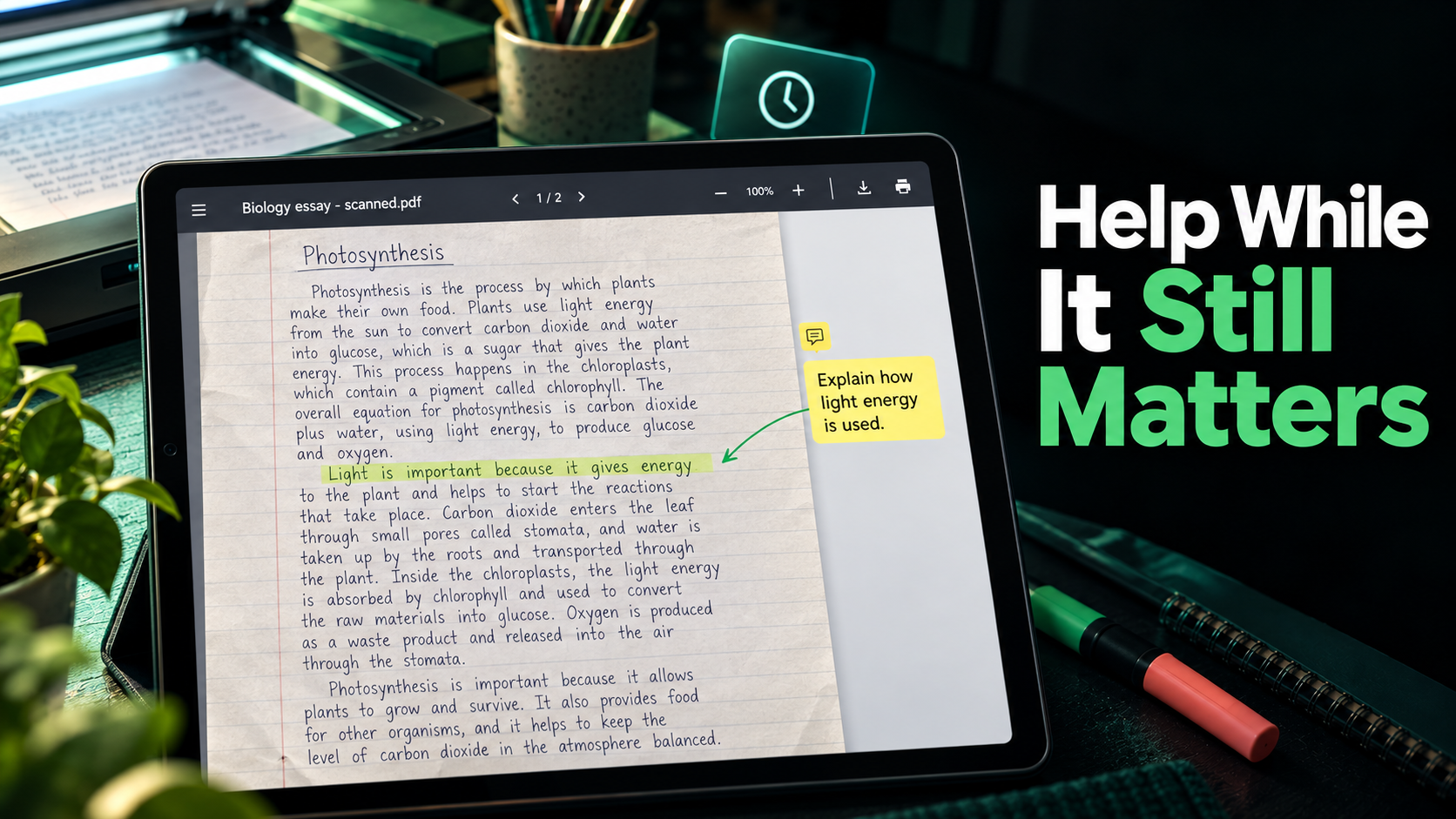
While educators battle through piles of assignments, learners are left waiting for feedback. By the time their marks arrive, they may have moved on to another topic, missing the opportunity to correct misunderstandings while the work is still fresh.
Research from the Education Endowment Foundation highlights the importance of feedback that learners can understand and use to improve their work.
The Grading Studio helps shorten this process by preparing detailed feedback against the assessment criteria for educators to review. Learners see their marks, where they met expectations, and where improvement is needed.
Faster, more useful feedback also gives educators opportunities to provide timely support and incorporate regular formative assessments without substantially increasing their marking workload.
Giving learners the chance to act on feedback when it has the most effect is a real victory.
After all, a Jedi apprentice needs guidance before facing a new challenge.
Bringing Balance to the Assessment Galaxy
Of course, no assessment system is complete without accountability.
When marks affect progression, qualifications or professional competence, educators and institutions must be able to explain how decisions were reached.
The Grading Studio is designed to support this through a record of grading suggestions, supporting evidence, confidence ratings and the educator’s final decisions.
This creates a useful reference for moderation, reviewing marking consistency and investigating appeals.
Because The Grading Studio operates within Moodle’s existing Assignment grading workflow, educators can access its assistance where they already review submissions and record grades, rather than having to work in a separate grading platform.
The system is intended to complement existing institutional assessment processes, not replace them. Learner information must also be managed in accordance with applicable data protection requirements, including POPIA.
The result is an approach that combines the efficiency of AI-assisted grading with the oversight and accountability of human assessment.
Return of the Jedi: The Educator Remains in Command
For busy educators, the idea of a tool that could mark assignments for them must surely be the ultimate wish fulfilment. Imagine handing over that mountain of essays and receiving them back, graded and accompanied by useful feedback, without sacrificing your evenings and weekends!
With The Grading Studio, that dream is coming a little closer to reality.
It isn’t quite a magic wand (or a lightsabre). Educators still need to review the results and make the final decisions. But AI-assisted grading can take much of the repetitive work off their hands, freeing up time for what really matters.
More time for teaching. More consistent marking. Faster, more meaningful feedback. And valuable insights into where learners are struggling and how learning materials can be improved.
The marking wars may not be over, but educators finally have a powerful ally on their side.
May the marks be with you.
A Head Start on Marking: Introducing The Grading Studio
Discover how The Grading Studio is bringing AI-assisted grading into Moodle while keeping educators in control.
12 November 2026 | 09:00–09:45
Intelligence that assists. Expertise that decides.
Kerushan Naidoo
Head of Moodle Development
Kerushan has a decade of experience working wonders with Moodle. That’s why we rely on this man for the winning plan. He is an active Moodle community member and, either knows of the perfect plugin for your needs, or will customise and develop a plugin to meet your unique requirements.