
Mindful Design is the Key to Meaningful Engagement.
Mindful Design is the Key to Meaningful Engagement
Spot the Problem
Take a Look
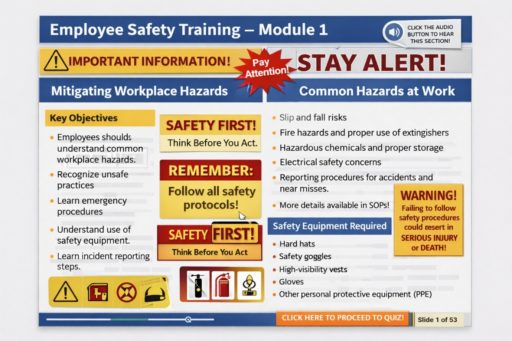
Before you read the rest of this article, we would like you to take a look at the above slide for 20 seconds. Take note of where you find the focal point and how long it takes you. When the 20 seconds is up, look away and try to remember what the main points of the content were. Did you notice that your eyes didn’t really know what to look at first? Do you remember what the multiple warning signs were warning you about? Did you manage to read all the text?
We chose 20 seconds because multiple studies indicate that the average time spent by a learner engaging with one e-learning slide ranges from between 20 to 60 seconds. This depends on a few factors, including how much text is onscreen and how motivated the learner is, among others.
We’re willing to bet that in 20 seconds you didn’t have time to absorb the actual message. Nevertheless, if you review the text, you will see that the content is sound. It says exactly what it needs to.
What’s the point we’re making here?
There is a common belief that learner engagement is driven purely by content quality. However, as just demonstrated, the quality of the content is not always the issue.
The problem is the design. You couldn’t engage effectively with the information because the design got in the way.
Admittedly, this is a crude example of good content, bad design but it does make the point.
You Don’t Have a Content Problem. You Have a Design Problem:
Few organisations suffer from a shortage of content. They have ‘raw material’ in the form of policies and procedures, SOPs and compliance documents. Some have gone a step further and invested in creating interactive training material like slide decks, presentations and videos. Others have made the leap to active hybrid or e-learning. Their content is generally of good quality and there is enough.
Yet regardless of the volume, quality or delivery of the content, engagement and therefore retention, remains low. Why? It comes down to the fact that engagement does not come from what learners are told. It comes from how the learning is structured, sequenced, and experienced.
High engagement is the result of thoughtful learning design that guides behaviour, builds momentum, and keeps learners involved

What do we mean by Design?
Design has two facets: First, the overall design of the learning environment and flow, and second, the design rules for the visual presentation. Both of these elements are subject to the same rules and principles, but we interpret them slightly differently depending on the context.
A guiding principle for any design is this one described by Donald A. Norman in his famous book, The Design of Everyday Things:
When e-learning design works, it doesn’t interfere with our experience of the content – the design is invisible but without it we would be subject to an experience like our slide above – pure chaos!
Design Principle: Content Is Raw Material. Design Is the Engine.
Content informs. Design directs.
Without structure, content becomes noise.
With structure, content becomes momentum.
Our focus in this blog is mainly on the first facet: the overall design picture.
Structure: How Learning Is Organised
Structure is the foundation that makes engagement possible. When learning is well structured, learners can see the path ahead of them. Clear goals explain what they are working towards and why it matters.
Defined learning paths help them understand the purpose of each step, which strengthens motivation and reduces uncertainty. Structure also includes breaking content into smaller, manageable chunks so that learners are not overwhelmed by information. This “chunking” approach reduces cognitive overload and allows learners to focus on one idea at a time.
Scaffolding gradually shifts responsibility from facilitator to learner, building confidence and independence along the way. Good structure makes learning feel guided rather than chaotic.
Sequencing: How Learning Is Ordered
Sequencing determines how ideas unfold over time. It ensures that learning progresses logically, rather than feeling like disconnected pieces of information. Effective sequencing often moves from simple concepts to more complex ones or begins with a real-world problem and then introduces the knowledge needed to solve it. This logical flow helps learners make sense of what they are learning and keeps them engaged.
Strong sequencing also connects new knowledge to what learners already know, encouraging immediate application rather than delayed practice. As tasks increase gradually in difficulty, learners remain challenged but not overwhelmed. When sequencing is intentional, learning feels coherent and purposeful instead of fragmented.
Experience: How Learning Is Lived
The experience of learning determines how active and invested learners become. Passive exposure to information rarely sustains engagement. In contrast, active learning experiences invite learners to participate through simulations, case studies, role-play, discussion, and problem-solving activities.
These methods require thinking, deciding, and application, not just reading or listening. Experience also includes the emotional and social dimension of learning. When learners receive timely feedback and feel connected to others, a sense of safety and belonging develops, which strengthens engagement. Personalisation further deepens investment by allowing learners to move at their own pace or make choices within the learning journey. When structure and sequencing are supported by a meaningful experience, engagement becomes a natural outcome rather than a forced one.
Shaping Behaviour:
Decision points, interaction, and feedback loops are the mechanisms that turn information into behaviour. When learners are asked to make choices rather than simply absorb content, they become active participants in the process.
Each decision creates ownership, and each consequence strengthens understanding. Interaction keeps attention focused by requiring thought, judgement, or action. Feedback loops then close the gap between effort and improvement, showing learners what worked, what did not, and how to adjust.
Over time, this cycle of choice, response, and refinement builds confidence and shapes behaviour far more effectively than passive exposure to information alone
How We Work: Transforming Existing Content
At The Learning Studio, we begin with what is already there: policies, slide decks, manuals, compliance materials and transform them through intentional learning design. We identify behavioural friction points, re-sequence material for clarity, embed decision moments, create visible progress, and design feedback loops that build momentum across the learning journey. As learning design specialists, we focus on engagement mechanics and behaviour, turning static material into structured, meaningful learning experiences. We work hard to ensure that the design is invisible but precisely fits the needs.
Design Principle: Engagement Must Be Designed Upfront
Engagement cannot be “added” at the end.
Design must begin with:
- Behavioural intent.
- Decision architecture.
- Sequencing strategy.
- Feedback planning.
Engagement is not a final layer.
It is a foundational blueprint
Join the Conversation
In our webinar we unpack how intentional learning design transforms existing content into engaging learning journeys that shape real behaviour. Why not join us live or watch it later for some insight that may help you rethink how you approach learning engagement and excellent design
Dennis Lamberti
Head of Content Development
As a founding member of Media Works, a company that helped educate over 1.5 million adults in South Africa, Dennis has honed his expertise in developing learning programmes for nearly 30 years . His focus is now on learning pedagogy and cognitive load balancing.